


'If I'd just done good things, I would never have blown up.' One sentence that sums up everything wrong with social media.
- Thomas Clark

- Mar 17
- 5 min read
I watched Louis Theroux's Inside the Manosphere. Here's what I thought (not that anyone asked).
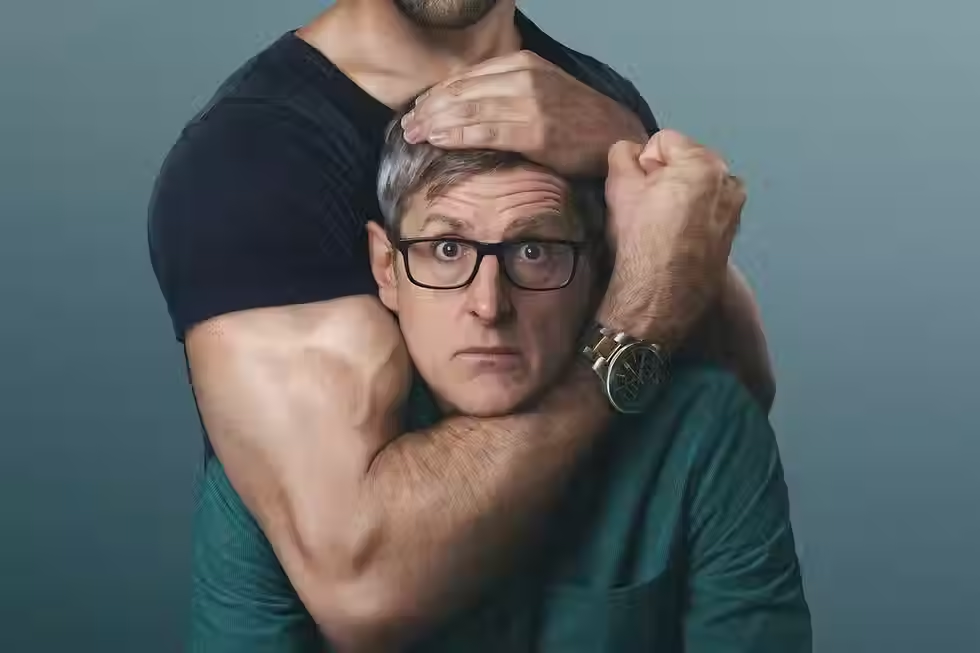
I'm a guy who grew up with social media in late teens and early 20s. My algorithm knows exactly who I am.
Andrew Tate. HSTikkyTokky. Sneako. These aren't names I searched for. They arrived, gradually and then all at once, until they were just part of the furniture of my feed. Videos saying harmful and at times hateful things about women, about gender, about how men should treat the people around them. And every time, my immediate reaction is visceral. This is wrong. This is not how I see the world. This is certainly not the way I think about women or the people in my life.
But then I would look at the numbers. 3.6 million views. Hundreds of thousands of likes. Comment sections full of "king", "this is so true" and "finally someone has said it." And something subtle starts to happen. Not a change in what I believe, but a slow erosion of my confidence in it. Is this actually the majority view, and I'm the outlier? Have I somehow ended up with the minority opinion?
What makes this harder is that social media is, despite everything it promises, a deeply lonely experience. You often scroll alone. There's no one beside you to nudge and say "this is insane, right?" It's just you, your reaction, and what appears to be millions of people nodding along. I know what I think. I know how I feel. But with enough saturation, enough repetition, you start to lose your bearings on what is considered normal. Not your values, but your sense of where those values sit relative to everyone else. And that gap, between what you believe and what the feed tells you everyone else believes, is an uncomfortable place to spend a lot of time.
That's the context in which I watched Louis Theroux's Inside the Manosphere, which landed on Netflix last week. And I'll say this: it was unexpectedly reassuring.
Seeing these figures plainly and clearly examined, their contradictions laid bare, their worldviews questioned, reminded me that what they peddle is very much on the extreme edge. It is not the consensus. It just gets plastered everywhere because the platforms reward it.
Where the documentary lands well
Theroux does what Theroux is good at. He gets access that nobody else gets, and his deliberately non-confrontational style allows his subjects to reveal themselves more honestly than they would under direct challenge. The documentary does a good job of exposing the commercial logic underneath all of it. These typically aren't ideologues driven purely by conviction of their beliefs. They are, in many cases, people who have discovered that provocation is the most scalable product available to them.
The exchange that stuck with me most involves a social media influencer called 'HSTikkyTokky'. When asked about the morality of his content, he is remarkably candid: "I don't give a f@#$. I'm doing it for money. I don't care about the morality of it. I know it's not good."
Theroux then asks him why he doesn't try to be a good person instead. Why not encourage people to make better choices rather than pandering to their worst impulses?
His answer is the most honest and damning thing I've heard anyone in this space say out loud.
"If I'd just done good things, I would never have blown up on social media in the first place."
In one sentence, he was able to provide one of the most damning summations of modern day social media. He knows exactly what he is doing and why. The platforms are designed to amplify content that generates the strongest emotional response. Outrage, provocation, and moral controversy are not bugs or errors in the system. They are features. And when the reward is money, reach, and notoriety, it turns out that some people are willing to say almost anything to get there.
Where it falls short
The documentary has real gaps, and I think it's worth naming them.
The most significant is the absence of women's voices and experiences. Theroux follows these figures closely, and we do briefly hear from some of the women around them such as their partners. But the documentary largely treats the manosphere as a story about men. What men believe, what men say, how it shapes the thinking of other young men.
The problem is that arguably the most serious consequences don't stay contained within that online world. The beliefs formed inside the manosphere don't just shape how young men think about women in the abstract. They shape how those men then behave toward women in real life. The documentary gestures at this but never really follows the thread. It shows us the ideology, briefly acknowledges that it filters into the minds of young men, and then largely stops there. What it doesn't explore with any seriousness is where that ends up, in the dynamics of relationships, in attitudes toward equality, in patterns of behaviour that have very real, and sometimes very dangerous consequences for women. That is not a minor gap. It is arguably the most important part of the story, and it is largely absent.
The second gap is that the algorithm gets off too lightly. The HS exchange comes agonisingly close to naming the structural problem, and then the documentary moves on. These men are able to operate the way they do because the systems reward them for it. Pointing a camera at the people exploiting the system, without seriously interrogating the system itself, means the documentary only tells half the story.
Social media companies have built platforms that profit from exactly this kind of content. There is no meaningful accountability placed on them for what those platforms produce, and there absolutely should be. The manosphere did not emerge in a vacuum. It was amplified, monetised, and distributed at scale by companies that have consistently chosen profit over people. That part of the story deserved more than a passing mention.
Why it still matters
Despite those shortcomings, I think this documentary is worth watching. Not because it will change the minds of anyone already deep inside the manosphere. It won't. But because for young people swimming in this content every day, quietly wondering whether their discomfort with it makes them the odd one out, there is real value in seeing it examined plainly and called what it is.
The manosphere is loud. It is extremely well distributed. And it is, by design, built to feel like the majority opinion.
It isn't. And sometimes it helps to have someone say that clearly.


Comments